Decision guide
Should this make the bag?
A review should tell you who it helps, where it bites, and what to check before you spend.
Fit check
Buy for the job, not the logo
If the product does not solve a real weekend-golfer problem, the specs are just expensive confetti.
Trust check
Read the tradeoffs first
Bogeylicious should surface the “don’t buy this if…” caveat before the retailer click, even when the pick is solid.
Next click
Compare the closest alternatives
When the article puts you in shopping mode, the next module should help you compare or save the decision — not just dump more links.
Browse Launch Monitor Comparisons →Quick Answers (What Most Golfers Actually Need to Know)
- Best for: Dedicated indoor simulator builds where accuracy matters more than portability.
- Biggest advantage over competitors: Photometric + radar hybrid sits beside the ball, cutting required room depth by 4-5 feet.
- Hidden cost to budget for: Software subscriptions add $100-$200/year on top of the hardware.
- The deal right now: SkyTrak+ is being discontinued as the ST MAX takes over. Clearance pricing at $1,995-$2,495 makes it the best value indoor monitor on the market.
Here's the thing about the SkyTrak+: it's the rare piece of golf equipment that's actually better to buy now that it's "old."
The ST MAX just came out. Retailers are clearing SkyTrak+ stock. The core measurement tech is essentially identical. You're getting a $3,000 monitor for closer to $2,000. That doesn't happen often in golf.
But "good deal" doesn't mean "right for you." If you're building your first home simulator, there are questions the price tag won't answer — like whether your garage is deep enough, whether you'll actually use the subscription software, and whether the SkyTrak+ beats the Mevo Plus for your setup.
Let's get into all of it.
What the SkyTrak+ Actually Is
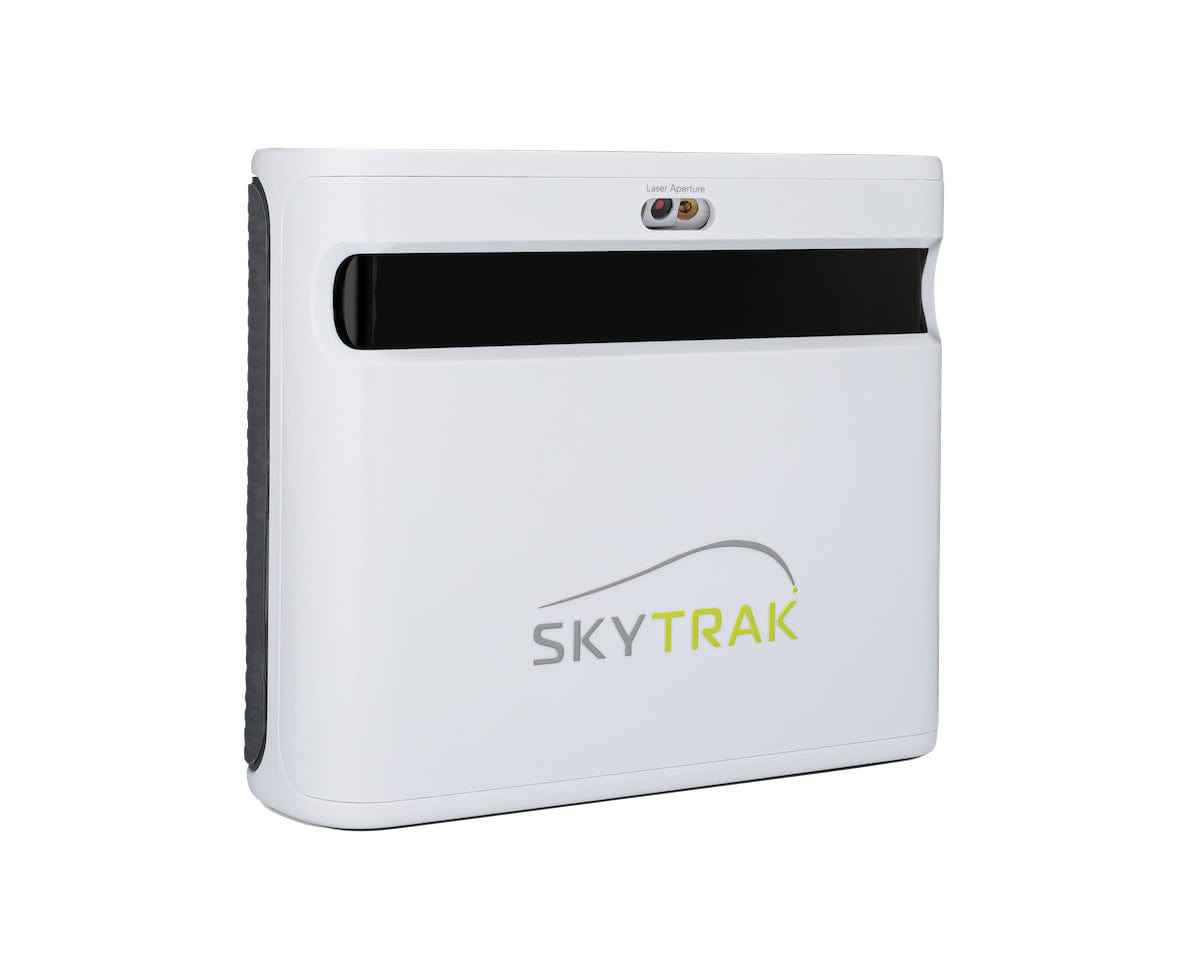
The SkyTrak+ is a photometric launch monitor with supplemental Doppler radar. In plain terms: it uses a high-speed camera to capture the ball at impact and radar to track club data. This dual-sensor approach is why it's so accurate indoors — it doesn't need to see the full ball flight to give you reliable numbers.
Ball data measured:
- Ball speed (±1% accuracy)
- Launch angle
- Back spin
- Side spin
- Spin axis
- Carry distance
- Total distance
Club data measured (new in the +):
- Club head speed
- Smash factor
- Face angle
- Club path
- Dynamic loft
- Angle of attack
The original SkyTrak couldn't do club data at all — that was the big upgrade that justified the "+" branding. And that club data is what separates a practice tool from a real improvement engine. Knowing your ball went 150 yards is useful. Knowing why — face was 2° open, path was 3° out-to-in, dynamic loft was 14° — is what actually changes your swing.
The Space Advantage Nobody Talks About Enough
This is the SkyTrak+'s killer feature that doesn't show up in spec-sheet comparisons.
Radar-based monitors (Garmin R10, FlightScope Mevo Plus) sit 7-8 feet behind the ball. That's 7-8 feet of room depth you need before the ball even reaches your hitting mat.
The SkyTrak+ sits beside the ball. Right next to it.
In practical terms, this means:
| Monitor | Required Room Depth |
|---|---|
| Garmin R10 | 18-20 feet |
| Mevo Plus | 18-20 feet |
| SkyTrak+ | 12-14 feet |
If you're converting a spare bedroom, a one-car garage, or a basement alcove, those 5-6 extra feet might be the difference between "it fits" and "it doesn't." That's not a marginal advantage — for a lot of home setups, it's the deciding factor.
Indoor Accuracy: Where It Earns Its Price
Ball speed accuracy within ±1% is the headline, and it holds up. On a 160 mph ball speed driver shot, ±1% means the SkyTrak+ is within 1.6 mph of a tour-grade system. For reference, the Garmin R10 is closer to ±3-5% — which at 160 mph means it could be off by 5-8 mph. Over a full swing session, that error compounds into unreliable club gapping.
Where the SkyTrak+ really separates itself: spin consistency on short game shots.
This is where cheaper monitors fall apart. A 60-yard pitch with a 56° wedge produces complex spin data that radar-based monitors struggle to capture without full ball flight. The SkyTrak+'s camera captures spin at the moment of impact — it doesn't need to track the ball for 50 feet to calculate it.
If you're someone who practices wedges and short game (and if you're a high handicapper, you absolutely should be), the SkyTrak+'s spin accuracy matters more than its ball speed accuracy. Cheap monitors will tell you a 60-yard pitch carried 58 yards. The SkyTrak+ will tell you and accurately report that it had 7,200 rpm of backspin at a 2° spin axis. That's the data that helps you learn trajectory control.
The Honest Downsides
It's indoor-first, outdoor-second. Direct sunlight messes with the camera. You can use it outdoors on overcast days or in shade, but if you want a monitor that travels easily between your backyard and your garage, the Mevo Plus or Garmin R10 are better choices.
It's not portable. At 2.2 lbs with a bulky form factor, you're not tossing this in your golf bag for a range session. This is a "set it up in the garage and leave it" device. If portability matters, look elsewhere.
Software subscriptions add up. The hardware is a one-time purchase. The software isn't. SkyTrak's Game Improvement plan runs $99/year. Play & Improve (which includes the Course Play simulator with 100,000+ courses) is $199/year. If you want E6 Connect or TGC 2019 on top of that, add another $150-$300/year. Over 5 years, you'll spend $500-$1,000+ on software alone.
Putting and chipping under 30 yards is unreliable. Like most launch monitors in this price range, very short shots don't register consistently. The ball speed is too low for the sensor to capture reliably. If your primary goal is dialing in your putting stroke, you need a dedicated putting system, not a launch monitor.
WiFi-only connectivity can lag. The SkyTrak+ connects via WiFi or USB-C. WiFi works but introduces occasional lag between your shot and the data appearing on screen. For the smoothest experience, go USB-C. This is a minor annoyance in practice sessions but noticeable during simulated rounds where pacing matters.
SkyTrak+ vs The Competition
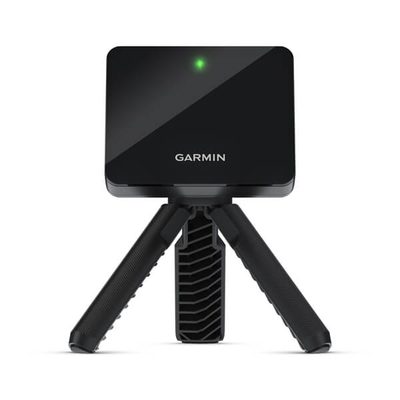
vs Garmin Approach R10 ($600)
The R10 is a fifth of the price. If budget is the primary constraint, it's still a great way to start. But the accuracy gap is real — especially on spin data and wedge shots. The R10 is a fifth of the price. If budget is the primary constraint, it's still a great way to start. But the accuracy gap is real — especially on spin data and wedge shots. The R10 gives you directional feedback (am I hooking or slicing?). The SkyTrak+ gives you diagnostic data (why am I hooking, and how much?). For a deeper dive into budget launch monitor tiers, see our complete launch monitor buyer's guide.
Buy the R10 if: Budget under $1,000. You want portable range data. Accuracy within ±5% is fine.
Buy the SkyTrak+ if: You're building a permanent indoor setup and want accuracy you won't outgrow.
vs FlightScope Mevo Plus ($2,000-$2,300)
This is the real head-to-head. The Mevo Plus is excellent — accurate, portable, great software ecosystem. It's the better monitor for outdoor use and for golfers who want one device that works everywhere.
The SkyTrak+ wins indoors. Better ball data consistency, smaller space requirement, and (at current clearance pricing) potentially cheaper. The Mevo Plus wins on versatility. For a detailed breakdown of budget launch monitor tradeoffs, check out our complete launch monitor buyer's guide.
Buy the Mevo Plus if: You want indoor + outdoor. Portability matters. You have 18+ feet of room depth.
Buy the SkyTrak+ if: Indoor-only. Tight space. Ball data precision is your priority.
vs SkyTrak ST MAX ($3,495)
Here's where it gets interesting. The ST MAX is SkyTrak's newest model — sleeker design, dual USB-C ports (data + charge simultaneously), improved alignment system, and software refinements.
The core measurement technology? Nearly identical to the SkyTrak+.
At full retail ($2,995 vs $3,495), the ST MAX is a reasonable upgrade. At the current SkyTrak+ clearance pricing ($1,995-$2,495)? You're paying $1,000-$1,500 less for 95% of the same experience. Unless the dual USB ports are make-or-break for your setup, the SkyTrak+ at clearance is the smarter buy right now.
vs Foresight GCQuad ($14,500)
Different universe. The GCQuad is the tour standard. The SkyTrak+ gets you within striking distance of its ball data accuracy at a fifth of the price. No serious weekend golfer needs a GCQuad. But if you're curious how close the SkyTrak+ gets: closer than you'd think.
The Complete Setup: What Else You Need
A launch monitor alone doesn't make a simulator. Here's the realistic budget for a full SkyTrak+ setup:
| Component | Budget Range | Our Pick |
|---|---|---|
| SkyTrak+ | $1,995-$2,995 | SkyTrak+ (clearance) |
| Impact screen | $200-$600 | Carl's Place HomeCourse Pro |
| Projector | $400-$1,200 | BenQ TH671ST (short throw) |
| Hitting mat | $150-$500 | Fiberbuilt Flight Deck |
| Enclosure/frame | $200-$800 | Carl's Place DIY frame |
| Netting (sides/ceiling) | $50-$150 | Impact netting from Amazon |
| Software subscription | $99-$199/yr | SkyTrak Play & Improve |
Realistic all-in cost: $3,100-$6,450
That's the real number. Marketing says "$2,995 for a home simulator." Reality says $4,000-$6,000 to do it right. Still a fraction of a club membership — and you'll use it more.
Compare Side-by-Side: See exactly how the SkyTrak+ stacks up against every competitor:
- SkyTrak+ vs Garmin R10 — budget vs precision
- SkyTrak+ vs FlightScope Mevo Plus — the real head-to-head
- SkyTrak+ vs SkyTrak ST MAX — old vs new
- SkyTrak+ vs Rapsodo MLM2PRO — mid-tier showdown
- Garmin R10 vs Rapsodo MLM2 Pro — budget radar battle
- SkyTrak+ vs Uneekor QED — portable vs overhead
- SkyTrak vs Foresight GC3 — high-end photometric battle
- Bushnell Launch Pro vs SkyTrak — entry-level photometric showdown
Or build your own matchup with our Launch Monitor Comparison Tool.
Who Should Buy the SkyTrak+ Right Now
Yes, buy it if:
- You're building a dedicated indoor simulator in a garage, basement, or spare room
- Your space is tight (under 15 feet deep) — the beside-the-ball placement is a genuine advantage
- You want ball data accuracy that won't hold your improvement back
- You can find it at the $1,995-$2,495 clearance price
- You primarily play/practice indoors and don't need strong outdoor performance
No, skip it if:
- You want a portable monitor for the range → get the Garmin R10
- You want indoor + outdoor versatility → get the FlightScope Mevo Plus
- You just want casual shot data → the R10 or Rapsodo MLM2PRO are plenty
- Budget is over $5K and you want the best → look at the Uneekor QED for overhead install
The move right now: If you've been on the fence about a home simulator and you can find the SkyTrak+ at its discontinued price, this is the window. Once clearance stock is gone, your option is the ST MAX at $3,495. Same tech, thousand more dollars.
📧 Weekend Golfer Newsletter — Get launch monitor deals, simulator setup tips, and gear reviews every Friday. No spam, just stuff that saves you money on your home golf setup.
The Bottom Line
The SkyTrak+ isn't the newest or the flashiest launch monitor on the market anymore. That's exactly why it's such a good buy right now.
The accuracy is proven. The technology is mature. The space requirement is the most practical in its class. And the clearance pricing makes it a value play that didn't exist six months ago.
For a weekend golfer building their first real home sim, the SkyTrak+ at $2,000 is the best entry point in 2026. Use the money you saved over the ST MAX to buy a better hitting mat or projector — those matter more than a second USB port.
If you already have a home sim setup and you're upgrading from an R10 or original SkyTrak, the SkyTrak+ is the sweet spot between "good enough" and "diminishing returns." Beyond this, you're paying for marginal gains.
Practice more, score better, and stop driving to the range in the rain. That's the pitch. It's a good one.
→ Check SkyTrak+ Price on SkyTrak.com{target="_blank"}
→ Already have your monitor? Use our Launch Monitor Comparison Tool to compare specs side-by-side, or check out the Best Home Golf Simulators 2026 guide for full setup recommendations.
Methodology
Methodology: we score products on intended use, value, setup friction, and downside risk so the recommendation reads like a real verdict, not a brand brochure.
Join the conversation
No comments yet